
Cold Roll Forming Production Line
Driven by global carbon neutrality goals and a new infrastructure recovery wave, sectors like steel structure buildings, photovoltaic mounting systems, and traffic barriers are experiencing explosive growth. According to the Steel Structure Development Association (SSDA), global steel structure production is projected to exceed 280 million tons by 2025, with cold-formed steel accounting for 32% of the total. This surge reflects the market’s urgent demand for high-precision, efficient, and flexible forming equipment.
Traditional cold bending processes face three major pain points: First, the material feeding efficiency is low, with manual feeding taking over 15 minutes per coil and posing safety risks. Second, forming accuracy is affected by roller wear and transmission lag, resulting in cross-sectional tolerance fluctuations exceeding ±0.5mm, which fails to meet the requirements of high-end applications like photovoltaic brackets. Third, product model changes require disassembling and reassembling rollers, with each change taking over 4 hours, making it difficult to adapt to the trend of multi-variety and small-batch production.
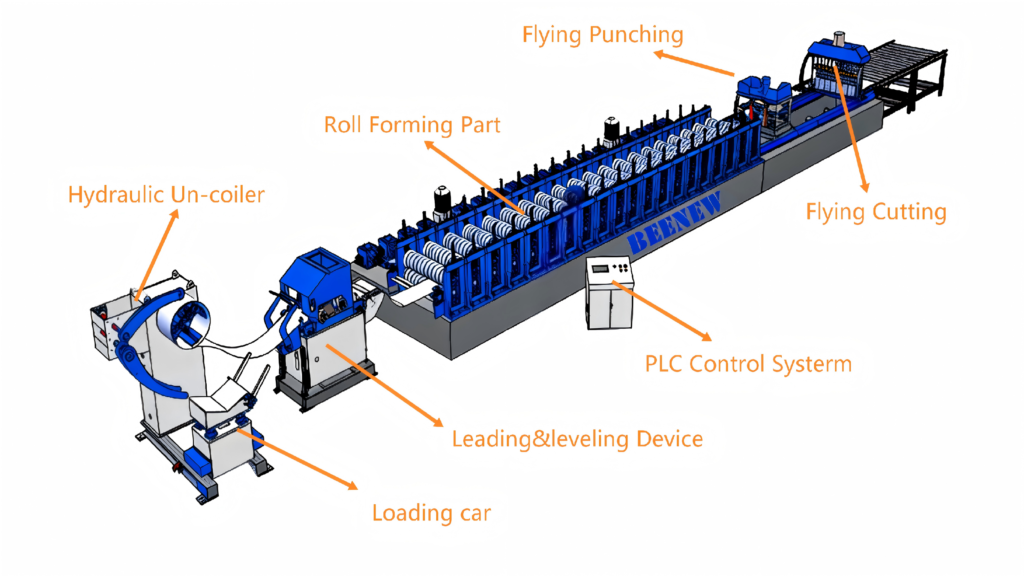
As a leading brand specializing in cold forming technology, Beewen Machinery’s fully automated cold forming production line was developed to address critical industry challenges. The modular architecture in the image demonstrates how this system not only automates the entire process from coil feeding to finished product cutting, but also redefines efficiency and precision standards in cold forming through core technologies like gearbox transmission and intelligent control systems.
1. Core Structure of the Product: A Full Process Analysis from Coil to Finished Product
The Beewen Machinery fully automated cold bending production line is not a standalone device, but a highly integrated system solution. By analyzing the six core modules in the image, we can clearly see its complete workflow from ‘coiled material → forming → finished product’:
1. Hydraulic Decoiler + Loading Cart: The First Line of Defense for Stable Feeding
The hydraulic uncoiler serves as the production line’s starting point, featuring a heavy-duty hydraulic drive system capable of handling up to 15-ton coils. It is compatible with cold-rolled steel, galvanized steel, and aluminum-magnesium-manganese alloy coils ranging from 300 to 1200mm in width. Its core advantage lies in the automatic centering function: by detecting the coil edge position through photoelectric sensors, the hydraulic system automatically adjusts the uncoiler’s position, ensuring the coil enters subsequent processes with a deviation of ≤±2 mm. This prevents forming defects caused by coil misalignment.
The integrated feeding cart features a hydraulic lifting mechanism that elevates the coil directly from the ground to the unwinder’s spindle height, eliminating manual handling entirely and reducing single-coil loading time to under 3 minutes. For heavy-duty coils, the cart incorporates anti-slip grooves and hydraulic locking systems to prevent slippage during transport. This design proves particularly effective for continuous production scenarios involving large-weight coils such as photovoltaic brackets and guardrail panels.
2. Forming Roller Part: The Core Carrier for Precision Molding
The forming roller system constitutes the technical core of cold bending forming. Beeneew Machinery’s production line features 18 sets of high-precision rollers made from quenched Cr12MoV die steel, achieving a surface hardness of HRC58-62. These rollers can withstand wear from forming over 100,000 tons of steel without deformation. Each roller set undergoes finite element analysis optimization, with a progressive bending design that distributes deformation stress across multiple rollers, effectively preventing cracking and wrinkling caused by localized stress concentration.
Notably, Beenew Machinery’s modular roller system enables quick replacement of roller assemblies across product lines through a fast-locking mechanism, with dedicated positioning pins that reduce type-switching time from 4 hours to under 45 minutes. This innovation effectively addresses the pain points of multi-product manufacturing, making it particularly suitable for steel structure plants that need to produce C/Z steel, floor slabs, and other profiles simultaneously.
3. Gearbox transmission + Motor: A high-efficiency and stable power unit
The power system determines the production line’s speed and stability. Beeneew Machinery employs a Siemens variable-frequency motor paired with a hard-toothed gearbox, delivering 75KW motor power for stepless speed control from 0 to 12m/min, achieving 30% higher linear speed than industry averages. The gearbox features a bevel gear design with 98% transmission efficiency, equipped with oil temperature monitoring and automatic lubrication systems. It operates continuously for 720 hours without failure, effectively addressing the common issues of belt drives—slippery operation and short lifespan.
For torque control, the system uses PLC to monitor forming resistance in real time. When encountering steel with excessive hardness, it automatically reduces linear speed and increases torque to prevent roller overload damage. This intelligent adaptation feature enables the production line to handle various steel grades from Q235 to Q355 without requiring additional equipment parameter adjustments.
4. Operation panel: The intelligent hub for human-machine collaboration
The control panel features a 15-inch touchscreen human-machine interface (HMI) with Beenew Machinery’s proprietary forming control system, supporting three operation modes:
- Automatic mode: After presetting product parameters, the production line automatically handles the entire process from feeding, molding to cutting, with operators only needing to monitor equipment status.
- Manual mode: For trial production or troubleshooting, you can control each module individually.
- Diagnostic mode: The system automatically collects device operation data, generates fault warning reports, and supports remote diagnostics and firmware upgrades.
The interface is also equipped with a parameter traceability function, which can record data such as forming speed, roller pressure, and cutting length for nearly 1,000 batches of products, facilitating quality traceability and process optimization. For export-oriented enterprises, the system supports multilingual switching to meet the operational needs of operators in different countries.
5. Cutting unit: The final step in precise measurement
The cutting unit employs hydraulic-driven flying saw technology, achieving cutting accuracy of ±0.3mm. It enables dynamic fixed-length cutting during continuous forming processes without machine downtime. The saw blade, made of cemented carbide, operates at a cutting speed of 120 cuts per hour and is equipped with an automatic chip removal and cooling system. The blade life is more than twice that of traditional cold saws.
To address the deformation issue of thin-walled profiles, Beenew Machinery has introduced a pre-clamping device before cutting, securing the profiles with hydraulic jaws to prevent cross-sectional deformation caused by vibrations during the process. This design is particularly suitable for manufacturing thin-walled, high-precision profiles such as photovoltaic brackets, effectively reducing the scrap rate of finished products.
Technical Core: Beenew Machinery’s Four Core Competencies
Beyond its modular architecture, Beenew Machinery’s fully automated cold bending production line demonstrates its technical superiority through meticulous refinement across four dimensions: precision, efficiency, intelligence, and durability.
1. High-precision forming: Industry breakthrough with ±0.2mm tolerance
The precision of cold-formed profiles directly impacts the assembly quality of downstream products. Beeneew Machinery has achieved an industry-leading cross-sectional tolerance of ±0.2mm through three key technologies.
- Roller machining precision: Manufactured using a five-axis CNC machining center, the roller achieves surface roughness of Ra≤0.8μm to ensure uniform force distribution during steel contact.
- Servo alignment system: A photoelectric alignment sensor is installed at the entrance of the forming roller conveyor to adjust the coil position in real time, with an automatic shutdown warning triggered when deviation exceeds 1mm.
- Online monitoring feedback: Before cutting, a laser diameter gauge is configured to monitor the profile cross-sectional dimensions in real time. The data is fed back to the PLC, which automatically adjusts the roller pressure to achieve closed-loop control.
This precision level meets the EU EN10162 standard and can be directly applied to high-end photovoltaic bracket markets in Germany, the Netherlands, and other countries without secondary processing.
2. High-efficiency output: From “mass production” to “flexible manufacturing”
The efficiency advantage of Beewen Machinery’s production line is demonstrated in three key aspects:
- Continuous production capacity: Supports 24/7 uninterrupted operation with a single-shift output of 12 tons, representing a 50% increase over traditional semi-automatic lines.
- Rapid model switching design: Modular rollers with quick-lock mechanism reduce switching time from 4 hours to 45 minutes, enabling efficient handling of diverse small-batch orders.
- Waste rate control: By implementing precision cutting and molding optimization, the waste rate was reduced from the industry average of 3% to 0.8%, saving over 200,000 yuan in raw material costs annually.
After adopting Beenew Machinery’s production line, a Zhejiang-based photovoltaic bracket manufacturer boosted its tracking bracket capacity from 800 to 1,500 tons monthly, with a sixfold increase in model conversion efficiency. This breakthrough enabled the company to secure multiple orders for large-scale photovoltaic power plants across Europe.
3. Intelligent Control: Forming Solutions in the Industry 4.0 Era
The intelligent control system integrated into Beewen Machinery’s production line incorporates three core Industry 4.0 features:
- IoT connectivity: Enables real-time upload of device status and production capacity data to enterprise MES systems via MQTT protocol.
- Predictive maintenance: Using vibration sensors to monitor the operational status of rollers and gearboxes, it provides 30-day early warnings for potential failures, preventing unplanned downtime.
- AI Process Optimization: An AI model trained on nearly 10,000 production batches automatically optimizes forming parameters based on steel material and thickness, significantly reducing manual debugging time.
For large corporate clients, Beenew Machinery provides remote maintenance services. Technicians can monitor equipment performance data in real time via cloud-based systems and troubleshoot remotely, reducing response time from 48 hours to just 2 hours.
4. Durability Assurance: Design with a Life Cycle of Over 10 Years
The durability of equipment directly determines its return on investment. Beenew Machinery extends equipment lifespan through three key design features:
- Heavy-duty frame structure: The frame is fabricated from welded H-beams, with annealing treatment to eliminate internal stresses, resulting in a 40% improvement in deformation resistance compared to conventional frames.
- Redundant design of key components: core components such as motors and gearboxes are configured with redundancy, allowing backup units to be activated in case of a single component failure without disrupting overall production.
- Corrosion-resistant treatment: All rollers and frame surfaces are coated with zinc spray and polyurethane, with a salt spray test lasting over 1000 hours, making them suitable for coastal areas with high corrosion.
Third-party test reports indicate that Beenew Machinery’s production line achieves an average mean time between failures (MTBF) of 12,000 hours, significantly exceeding the industry average of 6,000 hours. Moreover, the equipment retains over 35% residual value even after 10 years of operation.
Scenario-Specific Deep Adaptation: Comprehensive Solutions for All Industries
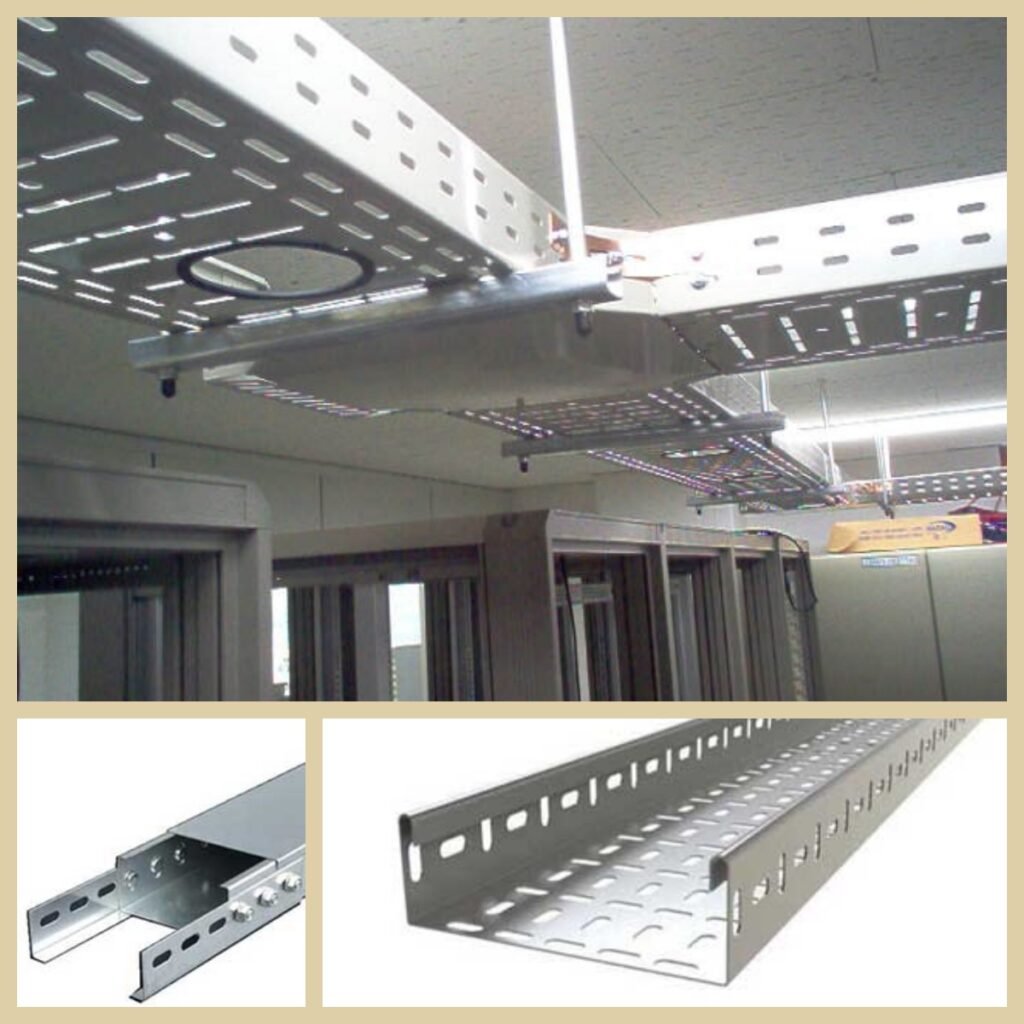
The modular design of Beewen Machinery’s fully automated cold bending production line enables it to accommodate nearly all cold-formed profile manufacturing scenarios. Here’s an in-depth analysis of its four core application domains:
1. Photovoltaic Mounting Frame: High-Precision Forming of Tracking Mounting Frame
With the global expansion of photovoltaic installations, tracking mounts have become mainstream due to their ability to boost power generation efficiency by 15-20%. These mounts demand exceptional precision in profile manufacturing, particularly with connection hole tolerances needing to be ≤±0.3mm to prevent rotational jamming. Beenu Machinery’s production line employs an integrated online punching and forming design, enabling hole processing during the forming process with ±0.2mm precision. The system also supports rapid switching between different hole types, meeting the customized needs of tracking mounts.
A Jiangsu-based photovoltaic company achieved a 40% productivity increase after adopting Beenew Machinery’s production line, reducing the defect rate of tracking bracket holes from 5% to 0.3%. This breakthrough enabled the company to secure supply chain partnerships with industry leaders including First Solar in the U.S. and Hanwha in South Korea.
2. Construction Steel Structure: Flexible Production of C/Z Steel
C/Z steel profiles serve as the core structural components in steel buildings. Conventional production lines face challenges in adapting to diverse specifications due to lengthy model switching cycles. BeeneW Machinery’s production line features a rapid model-switching design that enables seamless transitions from C to Z profiles within 45 minutes, with adjustable cross-section heights (100-300mm) to accommodate various span requirements. The automated punching unit integrated into the production line simultaneously creates installation holes for purlins, eliminating the need for additional processes and significantly boosting production efficiency.
3. Traffic Barrier: High-speed Forming of Wavy Barriers
Wave guardrails are essential safety infrastructure for highways, with China’s expressways requiring over 5,000 kilometers of new guardrails annually. Beeneew Machinery’s production line has optimized roller curve design for wave guardrails, utilizing 12 roller sets for continuous forming. The system achieves a linear speed of 12 m/min and a single-shift capacity of 15 tons, producing guardrails with uniform wave patterns and intact galvanized coatings that meet GB/T 31439.1-2015 standards.
4. Storage Racks: Efficient Mass Production of Columns and Crossbeams
Warehouse shelving systems require high load-bearing capacity for structural profiles, with columns specifically designed to withstand vertical loads exceeding 5 tons. Beeneew Machinery’s production line employs an enhanced roller design featuring 20 progressive bending stages, ensuring uniform mechanical properties across column cross-sections and achieving 10% higher yield strength than conventional methods. The system also supports in-line ribbing and punching operations, enabling simultaneous fabrication of reinforcement ribs and mounting holes during the molding process, significantly reducing production cycle time.
Customer Value Reconstruction: A Comprehensive Upgrade from Cost to Efficiency
For manufacturing enterprises, adopting Beenew Machinery’s fully automated cold bending production line signifies not just equipment upgrades but a complete transformation of production models. Here are the actual performance metrics from a steel structure company:
| metric | traditional semi-automatic line | Beenew Machinery production line | amplitude of increase |
| Single-shift capacity (tons) | 8 | 12 | +50% |
| Change time (minutes) | 240 | 45 | -81.25% |
| Scrap rate (%) | 3 | 0.8 | -73.33% |
| Manual requirement (person / shift) | 4 | 1 | -75% |
| Equipment uptime (hours) | 6000 | 12000 | +100% |
With a 4-ton production capacity per shift and a profit margin of 500 yuan per ton, the company gains an additional monthly profit of 60,000 yuan, and the equipment investment can be recovered within 18 months. Furthermore, the improved customer satisfaction from high-precision molding has reduced the order delivery cycle from 20 days to 10 days, significantly enhancing the company’s market competitiveness.
5. Comparing with Traditional Equipment: Beenu Machinery’s Competitive Edge
Compared with similar equipment on the market, Beene’s fully automated cold bending molding production line stands out in three key aspects:
1. Modular Design vs Fixed Structure
Traditional cold bending production lines typically feature fixed structures, requiring complete roller disassembly for model changes. In contrast, Beenew Machinery’s modular roller design allows independent replacement of roller assemblies for different products. With its quick-lock mechanism, the system boosts model change efficiency by over sixfold, making it particularly suitable for multi-product manufacturing enterprises.
2. Intelligent Closed-loop Control vs Manual Debugging
Traditional production lines rely on manual adjustments to roller pressure and speed, resulting in significant precision fluctuations. By implementing online detection and PLC closed-loop control, Beenew Machinery achieves automatic parameter optimization, tripling precision stability while reducing reliance on skilled workers.
3. Full Life Cycle Service vs Single Sale
Beenew Machinery provides end-to-end lifecycle services covering equipment selection, installation, commissioning, and operation and maintenance upgrades, including:
- Free technical training and operational guidance;
- 12-month full warranty and lifetime maintenance for the entire unit.
- Free equipment inspection and performance optimization twice a year.
This service model alleviates corporate concerns, particularly for small and medium-sized manufacturing enterprises with limited technical expertise, enabling them to swiftly acquire equipment operation and maintenance skills.
Selection Guide: How to Match Your Production Needs
When selecting a cold bending production line, consider your production capacity, product types, and budget. Here are Beenew Machinery’s recommendations:
1. Capacity demand: High-speed line vs Standard line
- High-speed line: With a linear speed of 12m/min, it is ideal for large-scale enterprises with an annual production capacity exceeding 20,000 tons, such as leading photovoltaic bracket manufacturers and major steel structure groups.
- Standard line: With a linear speed of 8m/min, it is ideal for medium-sized enterprises with an annual production capacity of 5,000-20,000 tons, such as regional steel structure factories and guardrail panel manufacturers.
2. Product type: complex section vs simple section
- Complex cross-sections: For applications like photovoltaic tracking brackets or automotive profiles, select production lines with over 18 roller sets to ensure precise forming.
- Simple cross-sections: For C/Z steel and guardrail panels, a production line with 12-16 roller sets can be selected to reduce equipment costs.
3. Degree of automation: fully automatic vs semi-automatic
- Fully automated production line: featuring material feeding carts, flying saw cutting, and real-time inspection, ideal for businesses prioritizing efficiency and precision.
- Semi-automatic production line: Requires manual loading and cutting, ideal for small businesses with limited budgets and stable order volumes.
4. Customized Services
Beenew Machinery provides customized roller solutions and optimized production line layouts, delivering tailored solutions based on factory dimensions and material specifications. For overseas clients, we offer export services including voltage adaptation and CE certification to ensure equipment compliance with local standards.
7. FAQ
Q1: What is the exact lead time for production line model changes?
A: For systems with pre-installed spare roller sets, the model replacement takes approximately 45 minutes. For new roller sets, the production cycle is 7-10 days. Pre-stocking of roller sets ensures faster order delivery.
Q2: What are the maintenance cycle and cost for the equipment?
A: The equipment requires monthly routine maintenance (including lubricant inspection and roller wear checks) and annual in-depth maintenance (gearbox oil change and sensor calibration). Routine maintenance costs approximately 0.5% of the total equipment price per year, while in-depth maintenance costs about 1% annually, both significantly lower than the industry average.
Q3: How long does the equipment installation and commissioning take?
A: The installation and commissioning period for domestic clients is approximately 15-20 days, while for overseas clients it is 30-45 days (including shipping and customs clearance). Beenew Machinery provides a professional installation team to ensure rapid equipment commissioning.
Q4: Can it accommodate raw materials of different materials?
A: The production line is compatible with materials such as cold-rolled steel, galvanized steel, and aluminum-magnesium-manganese alloy, with a thickness range of 0.8-3.0mm. The system automatically adjusts forming speed and roller pressure for different materials without requiring additional equipment modifications.
Future Trend: Intelligent Evolution of Cold Bending Forming Equipment
With the advancement of Industry 4.0 and IoT technologies, cold bending equipment is evolving toward smarter, unmanned, and eco-friendly solutions. Beenew Machinery has initiated the development of next-generation production lines, focusing on three key technological breakthroughs:
- Digital twin system: By leveraging the digital twin model of equipment, it enables virtual debugging and predictive maintenance, thereby further enhancing equipment efficiency.
- Unmanned workshop solution: Integrating AGV material handling and robotic palletizing to create a fully automated cold bending and forming facility.
- Energy-saving technology: Equipped with servo motors and energy recovery systems, it reduces energy consumption by over 30%, aligning with global low-carbon development trends.
These technologies will further solidify Beenew Machinery’s leadership in cold bending, delivering more competitive solutions to customers.
Conclusion: Join Hands with Beenew Machinery to Build the Future of Infrastructure
Amid the global infrastructure boom and industrial transformation, the efficiency and precision of cold bending equipment have become a key differentiator for manufacturers. Beeneew Machinery’s fully automated cold bending production line not only addresses the limitations of traditional methods but also delivers comprehensive value—from cost savings to operational efficiency—through its modular design, smart control systems, and end-to-end lifecycle support.
Whether it’s the high-precision requirements for photovoltaic brackets or the flexible production of steel structures, Beenew Machinery delivers customized forming solutions. As global carbon neutrality goals advance, cold bending technology will find broader applications. Beenew Machinery will continue to innovate, collaborating with clients to build a more efficient and sustainable industrial future.