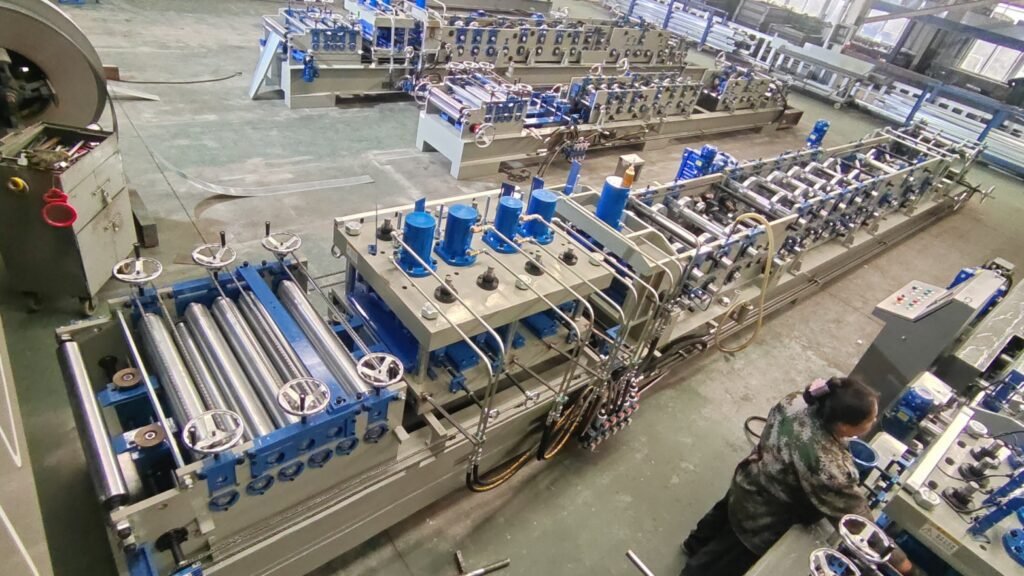
What Is a Roll Forming Machine?
What is a roll-forming machine?
A roll-forming machine is a specialized manufacturing machine used to form a continuous, uniform profile from flat metal sheets or coils into a consistent cross-sectional shape. Unlike traditional metalworking processes such as stamping or extrusion, which typically involve cutting, bending, or shaping the metal in steps, roll-forming occurs continuously, making it ideal for the mass production of long metal parts. This technology plays a key role in industries ranging from construction and automotive manufacturing to aerospace and consumer goods, where precision, consistency, and cost-effectiveness are paramount.
Beenew Machinery is a major manufacturer of roll-forming machines with 28 years of experience.
The core of the roll-forming process relies on a series of continuous rolling dies (or tooling) that gradually bend and shape the metal as it passes through the machine. The process begins by feeding a metal coil (typically made of steel, aluminum, copper, or stainless steel) into a decoiler, which unwinds the coil and feeds the flat metal strip into the roll-forming unit. As the metal strip passes through the machine, it passes over multiple sets of horizontally and vertically arranged roll rollers. Each set of rollers is carefully designed to apply specific pressure and bend the metal in small increments, rather than forcing a single, large bend. This incremental bending method ensures the metal maintains its structural integrity, avoids material fatigue, and maintains tight dimensional tolerances—typically as precise as ±0.1 mm—even for complex profiles.
One of the most significant advantages of roll forming is its efficiency in high-volume production. Unlike discrete manufacturing methods that require stopping and starting between parts, roll forming operates continuously, with production speeds ranging from 10 to 100 meters per minute, depending on material thickness and profile complexity. This continuous operation reduces labor costs, minimizes material waste (typically less than 5%, compared to 15-20% with stamping), and lowers unit production costs—making it ideal for mass-produced products such as building studs, automotive frame rails, or solar panel mounts. Furthermore, roll forming excels at creating complex, consistent profiles that are difficult or impossible to achieve with other methods. For example, it can produce profiles with multiple bends, closed sections (like tubes or channels), or integrated features like holes, notches, or embossing—all in a single pass on the machine.
Roll-forming machines are highly adaptable to diverse materials and applications. In the construction industry, they are widely used to produce steel columns, joists, roof panels, siding, and decking—materials that require strength, durability, and uniform dimensions to meet building codes. The automotive industry relies on roll-forming to manufacture frame components, door beams, roof rails, and exhaust systems, where lightweight yet strong metal profiles are crucial for improving fuel efficiency and vehicle safety. In the renewable energy industry, roll-forming is used to create support structures for solar panels and wind turbine components because it can produce long, consistent profiles that can withstand outdoor conditions. Even in the consumer goods sector, roll-forming facilitates the production of products such as shelving units, appliance frames, and furniture components, where precision and cost-effectiveness are key.
To learn more about roll-forming machines, click here.